
How Many AI Agents Are You Really Running
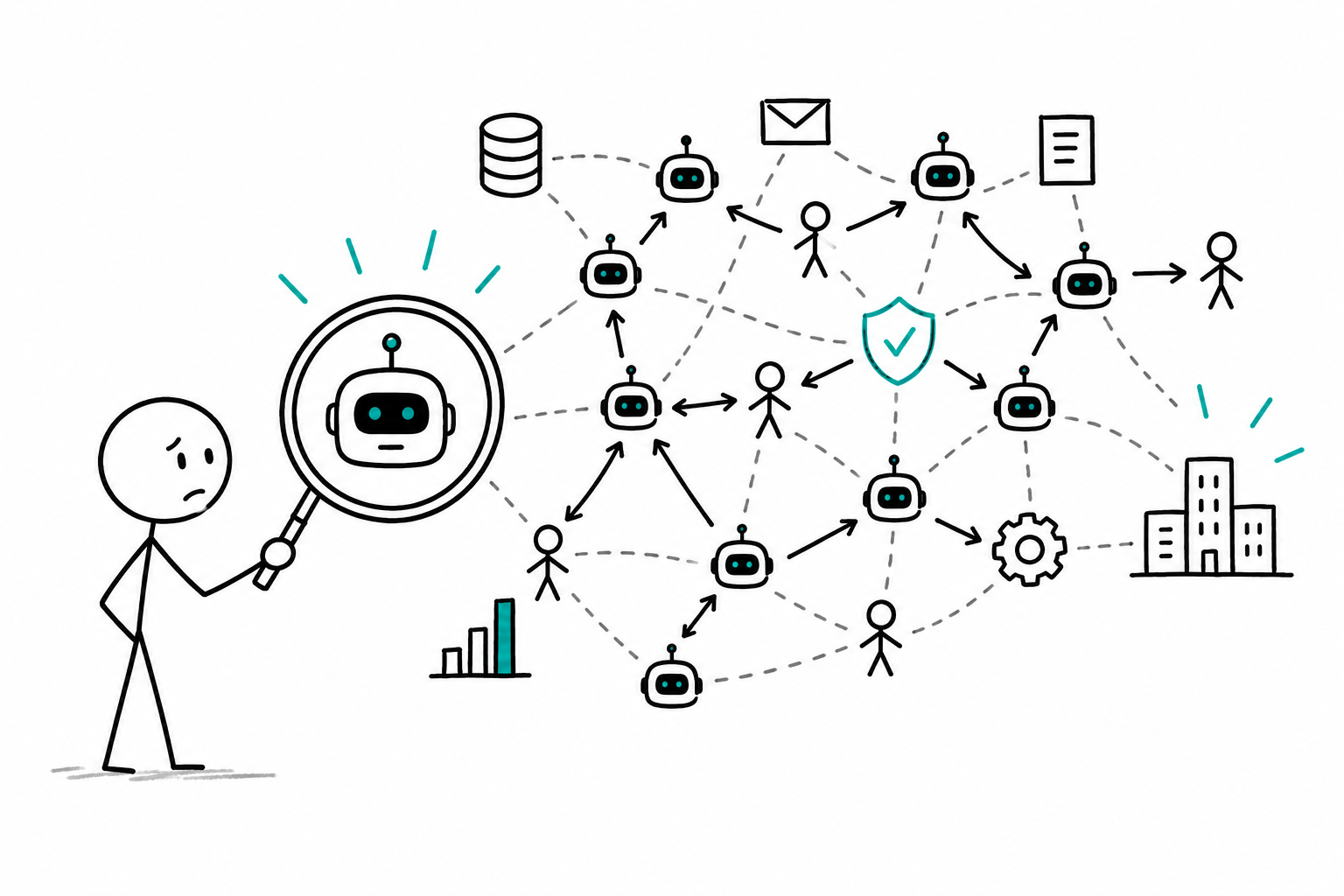
Every company has already lived through one AI adoption cycle. The next one is bigger, faster, and a lot less forgiving of guesswork.
Ask a room of leaders how many AI agents their company is running right now. Nobody has a clean answer. Someone guesses. Someone says they'll check with IT.
That's not a knock on anyone. Technology is just moving faster than anyone's tracking it. Sales spins up an outreach agent. Ops stands up a scheduling bot. Someone in finance adds an assistant into the expense system over a weekend because it worked, and nobody said not to.
Add it up and you've got a dozen agents doing real work, scattered across half a dozen systems, and no single individual could name them all or explain how they all interact.
That visibility gap is the real problem. Not the agents. The gap between how many you're running and how many you can actually see in one place is what separates the companies that scale AI well from the ones that spend the next three years cleaning up after it.
Gen AI was the warm-up
Most companies have already been through one AI wave: a chatbot drafting emails, a copilot writing code, something summarizing the meeting nobody had time for. It was quick, it was manageable, and nobody had to rethink how the business runs.
Agents are a different animal, and most companies are just getting started with them. A chatbot drafts something for a person to check and send. An agent decides, acts, and moves on to what's next, on its own. That feels manageable today. It won't stay that way.
In our experience working with companies going through this shift, agent counts tend to climb quickly once the first few prove useful — often reaching the dozens within a year or two. Nobody plans that rollout, exactly. It happens because every team that finds one agent useful adds a few more. And as that count grows, agents increasingly hand work directly to each other and to multiple people on a team, rather than reporting back to just one person.
A few dozen agents doesn't sound like much. Until you look at the math.
The math nobody's doing
Most leadership teams think about agent count the way they think about headcount: more agents, more capacity, roughly a straight line. That's the wrong model, and it's worth seeing why.
The number of possible connections between your agents doesn't grow with the agent count, it grows much faster than that. Two agents is one possible connection to keep track of. Ten agents is 45. A hundred agents is 4,950. In practice, not every pair of agents will actually interact — but even a fraction of that number is more coordination surface than most teams are tracking today.
Each active connection needs to be governed. Someone has to be watching for the moment something's off, with a clear path to route it to the right person. That's the part that doesn't scale on its own.
Few companies sit down and approve a plan to manage that many connections. They approve "let's give every team an agent," one team at a time, and the connections pile up whether anyone's watching or not.
The right question isn't "can I trust this agent"
That instinct, can I trust this agent to act safely, is a good one. It's just not the question that decides whether an AI program holds together once you're running 50 or 100 agents.
A hundred agents can each be perfectly safe on their own and still get in each other's way or combine to miss the intent of your business. Duplicating an email to a customer. Undercutting a price someone just set. Burning a morning on busywork while the task that actually mattered sits and waits.
Each agent can do exactly what it's supposed to do individually while the system of agents still doesn't do what you expected.
Part of the fix is guardrails, and they need to work at at least three levels: the individual agent, the group level of agents working together, and the organization as a whole. That's what gives you actual operational control, and a way to escalate the moment something falls outside what was intended.
A dashboard doesn't solve this.
A dashboard tells you what already happened. By the time something lights up, the decision's been made and the action is already out the door. Governance has to sit inside the decision itself, in real time, not show up after the fact.
The companies getting this right aren't necessarily slowing their agents down to do it. They're investing in agent operations and governance practices — many of which didn't exist as a discipline a few years ago — designed to catch problems inside the decision, not after it. Done well, that oversight becomes an enabler of scale rather than a brake on it.
What's this actually worth to you?
What is visibility worth to you? There's a good chance nobody at your company could tell you what your agents did this week. How many escalations were triggered. Which agents and which guardrails were impacted. Who handled the escalation and what action did they take? What were the decisions associated with any individual transaction? Every hour you can't see into this is an hour your agents might've acted outside what you intended, with no way for you to know.
What is governance worth to you? If one agent sends the wrong message to a customer or changes a record it shouldn't have touched, the cost of cleaning that up — in customer trust, in rework, in the time it takes to even find out it happened — is worth weighing against the cost of building oversight in from the start.
What is routing to the right human worth to you? When something needs a human and it lands with the wrong one, or no one, that decision gets stuck, ignored, or made by accident. As agent count grows, this stops being a rare edge case and becomes a routine operational question. Getting each escalation to the person with both the expertise and the authority to act on it is what makes routing actually work, and that's rarely the same person twice.
What is a continuously improving system of agents and humans worth to you? Is your system of agents getting better, or just repeating itself? An agent that doesn't learn from what just happened will make the same mistake again, and that's true of the whole system, not just one agent. Every escalation is a chance to improve. Are you capturing that, or does every cycle start back at zero? Your agents will need to evolve and your guardrails will need to evolve, and your humans-in-the-loop will have to evolve so that they match your business intent and the change in your business over time.
Only your business can answer these for you. But if you can't answer them quickly right now, that's worth treating as a risk you haven't measured yet.
The opportunity in front of you
Trust in how a company deploys AI gets earned in moments like this one, with decisions made now, while most companies still have a handful of agents rather than dozens.
Agent count is climbing across industries. Companies that build good habits early — while the number of agents is still small — will have an easier time than those who wait until coordination problems are already visible. That window won't stay open indefinitely.
Every company running more than one agent is facing some version of the same choice: end up with a growing number of uncoordinated moving parts, or build something a leader can actually explain to a customer, a regulator, or a board.
It's worth asking now: could you walk through, with evidence, exactly how one transaction decision was made across multiple agents? Do you know how many guardrails triggered escalations today, what came out of them, and who signed off? Many companies can't answer that yet — but as agent use grows, these are the questions leaders, boards, and regulators are increasingly likely to ask.