
Control, Operations, Change: The Three Things Your AI Agents Cannot Survive Without
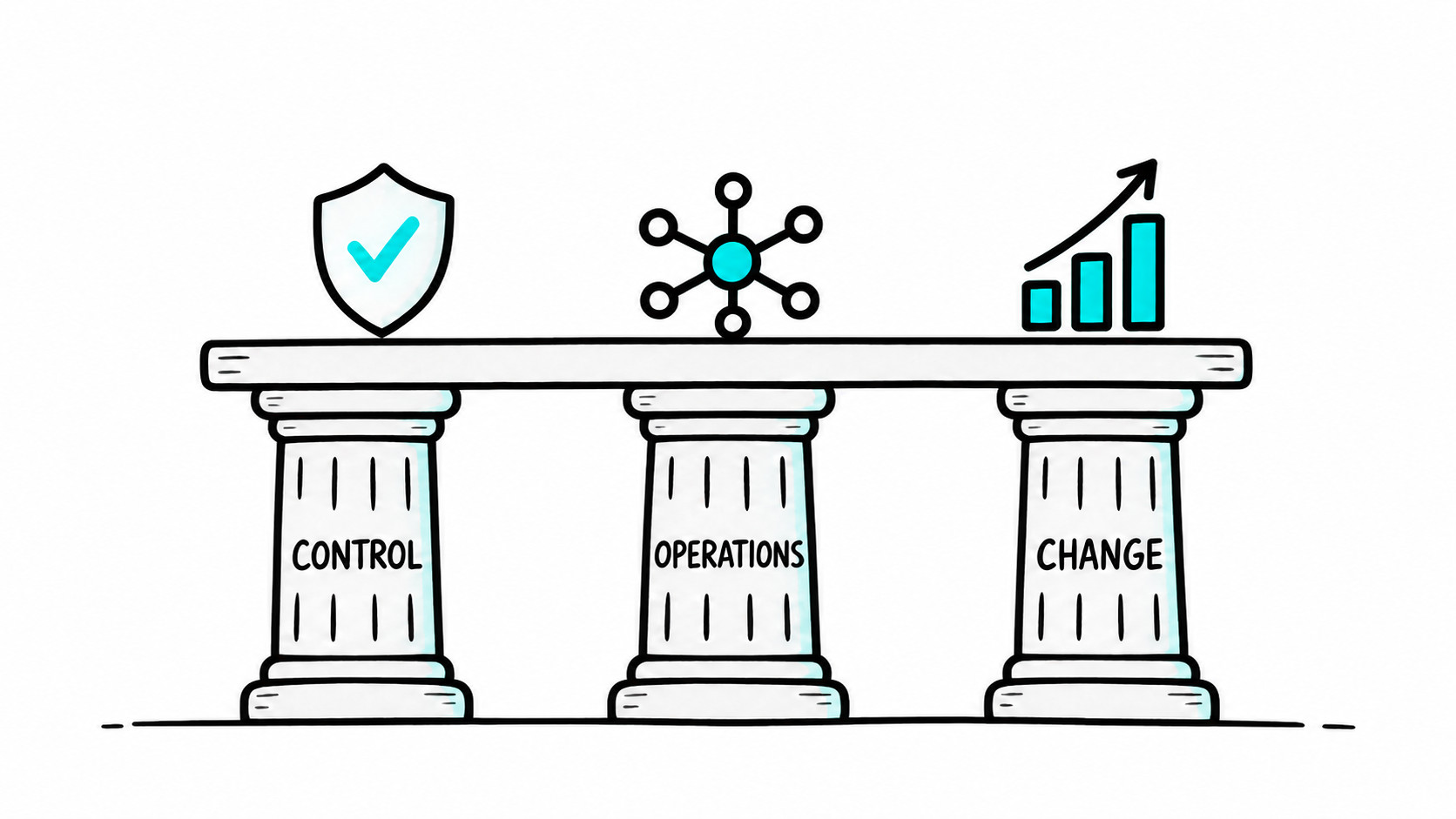
Every company building agents is optimizing for the same three outcomes: AI Safety, AI Scale, and AI Results. Fewer companies realize those outcomes rest on three prerequisites that have nothing to do with how the agent was built.
Agent Control. Agent Operations. Agent Change.
Skip any one of them and your system doesn't just underperform. It often fails outright, or it atrophies so slowly you don't notice until the damage is already compounding.
Agent Control: the prerequisite for AI Safety
Agent Control is the ability to see what every agent is doing, enforce the guardrails that govern it, and stop or redirect it the moment it steps outside the boundary the business set.
This is not a permissions setting buried in a developer's config file. Control means the business, not the build team, defines what "safe" means for a given agent, and that definition holds no matter who built the agent, when they built it, or what platform it runs on.
Without Control, safety is a hope, not a system. You are trusting that whoever wrote the agent thought of every edge case, and that the edge cases haven't changed since. They have.
Agent Operations: the prerequisite for AI Scale
Agent Operations is the discipline of running agents as an interconnected portfolio instead of a pile of independent projects. It is monitoring performance across agents, catching drift before it becomes damage, and routing exceptions to the people who can actually resolve them.
Scale is not "more agents." Scale is more agents that stay coordinated, stay accountable, and stay visible as their number grows. Ten agents built by ten different teams on ten different platforms is not scale. It is ten silos that happen to share a budget line.
Without Operations, every new agent you add makes the system harder to trust, not more capable. You are scaling complexity faster than you are scaling value.
Agent Change: the prerequisite for AI Results
Agent Change is the ability to update how agents behave, once, from the business, and have that update apply correctly and immediately across every agent it should touch.
Results come from a system that improves continuously: a policy shift gets reflected everywhere it matters, a lesson learned in one agent strengthens the others, a decision made once doesn't have to be remade a hundred times. Without Change, every improvement is local. It lives in one agent, made by one developer, and it dies there too.
Without Change, you don't get results. You get a snapshot of results, frozen at whatever moment someone last had the time to update the code.
These are business functions, not IT functions
Here is the mistake nearly every organization makes: assuming Control, Operations, and Change are the responsibility of the developers, IT, or "the AI team."
They aren't. A developer can build the safest, best-operating, most well-architected individual agent in the world, and none of that answers the actual question a business needs answered: who governs it, who's watching it, and who can change it, next month, without needing the person who built it.
Developers own the build. IT owns the infrastructure. Neither owns the operating discipline that keeps a portfolio of agents aligned with the business as the business changes around them, because that discipline was never a technical problem to begin with. It's a management problem, and it belongs to the people who own outcomes, not the people who own code.
Treating Control, Operations, and Change as engineering concerns is why so many agent programs work beautifully in the pilot and quietly rot six months later. The pilot had a developer paying close attention. Production doesn't.
This has to live in one system, built for the business
Here's where most organizations go wrong even after they accept the first point: they try to solve Control, Operations, and Change as three separate problems, with three separate tools, usually bolted onto whatever platform built the agent in the first place.
That doesn't work, because Control, Operations, and Change aren't three functions. They're one discipline, viewed from three angles. The same visibility that lets you enforce a guardrail is what lets you spot drift. The same view that shows you an agent's performance is what tells you which agents a policy change actually touches. Split them across separate tools and you've rebuilt the silo problem you were trying to solve, just one layer up.
They belong in a single, purpose-built system, one place where the business can see every agent, govern every agent, and change every agent, regardless of who built it, what platform it runs on, or how long ago it shipped.
This is exactly what ForceEquals was built to be. Not another agent framework, not another place to build agents, but the governance layer that sits above every platform you already use, whether that's Salesforce Agentforce, ServiceNow, Microsoft Agent 365, or something your own team built from scratch. One system, purpose-built for Control, Operations, and Change, so your agent portfolio behaves like a single governed system instead of a hundred independent experiments.
And that system has to be handed to the business, not locked inside engineering. Your compliance lead shouldn't need a developer to enforce a new guardrail. Your operations lead shouldn't need a ticket filed to see where an agent is drifting. Your legal team shouldn't need to track down whoever wrote the code eight months ago to apply a policy change today. Give your business teams the toolset itself: the ability to tune, adjust, and correct the agents running their part of the business, directly, the same day the business needs it, not whenever engineering has the bandwidth to get to it.
That's the difference between an agent program you own and one you're merely hosting. Agents don't stay valuable on their own. Someone has to keep tuning them, every day, against a business that keeps changing. The only question is whether that someone is the business itself, working in one system built for exactly this, or a developer you have to go find.
Why this gets more critical, not less, as you scale
At five agents, you can get away with informal Control, ad hoc Operations, and manual Change. Someone remembers who built what. Someone can still hold the whole system in their head.
At ten agents, that stops being true. At a hundred, the cost of not having Control, Operations, and Change stops being theoretical.
Legal changes a policy tomorrow, and it affects thirty of your hundred agents. Do you want to track down the developers who built each of those thirty, some of them eight months or a year ago, some of them no longer at the company, and hope every one of them applies the update correctly? Or do you want legal to make the change once, in one place, and have the system find and update exactly the right thirty agents, instantly, with no developer in the loop at all? That is Control. That is Operations working the way it's supposed to. That is Change management, done right.
Now say you're getting drift across a multi-agent workflow: small deviations building up across several agents that talk to each other. Do you want to hope someone notices, and that whoever notices can even see the impact across multiple agents at once? Or do you want an automatic escalation, with full context and every impacted agent named, routed to the business people who have the expertise and the authority to actually decide what to do, and who can then deploy a fix that updates performance across the whole workflow, from one place, instead of patching a hundred individual silos?
And when your agents generate insight, an edge case handled well, a pattern worth reusing, a mistake worth learning from, do you want that learning captured once and shared across the whole portfolio? Or scattered across a hundred silos, known to whichever agent happened to encounter it, and invisible to the other ninety-nine?
The math is not forgiving. Every agent you add without Control, Operations, and Change doesn't just add its own risk. It adds interaction points with every other agent already running. The complexity compounds long before anyone planned for it to.
Agent Control, Agent Operations, and Agent Change are not features you add once your agent program matures. They are the floor your agent program stands on. Build the floor first, in one system, and put it in the hands of the people who own the business, or find out the hard way that you were building on a floor that was never there.