
How ForceEquals Agent Momentum works, and example use case impact
ForceEquals is purpose-built for a problem that's new to most companies: how to control and operate AI agents in the real world, at scale, inside day-to-day business operations. Getting an agent deployed isn't the hard part anymore. Making it succeed, keep delivering impact, stay tuned to what's actually happening on the ground, and adapt as the business changes around it — that's the part nobody's solved yet. The same approach applies no matter the platform, the industry, or how an agent was built. What follows is how it works, then seven real situations showing what that looks like in practice.
HOW IT WORKS
One Governance Layer, Above Every Platform
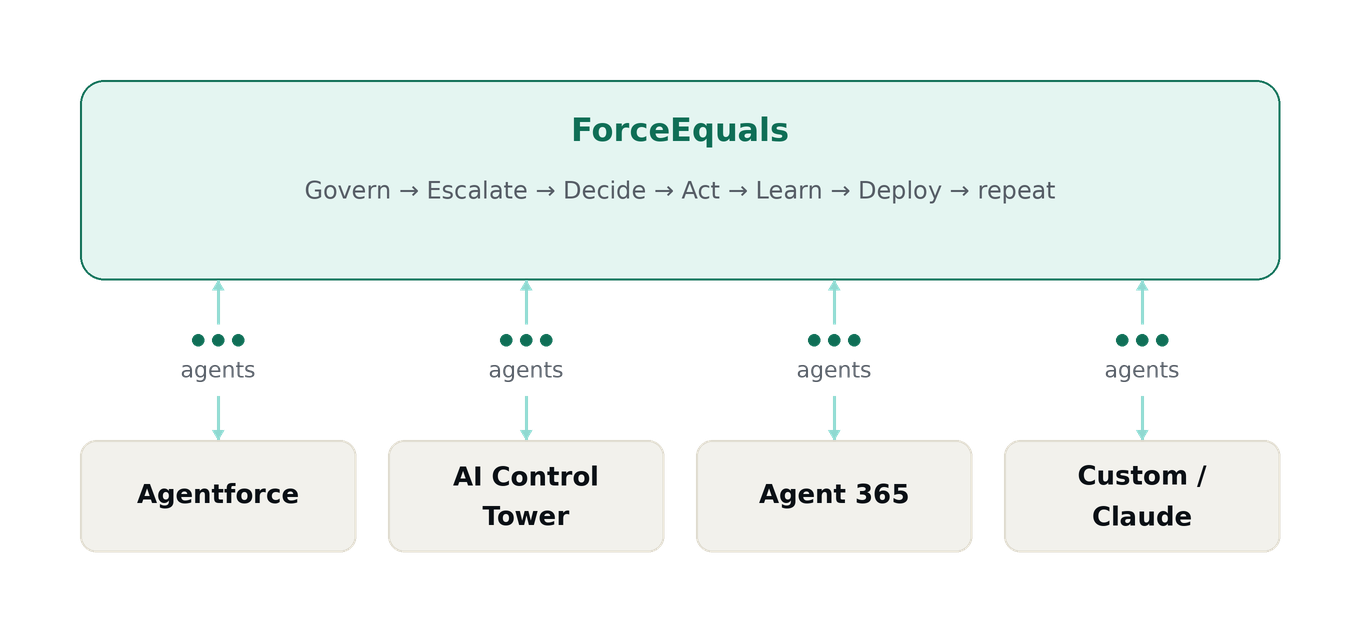
01 Connect any agent, regardless of platform, license, or how it was built, native Salesforce, native Microsoft, ServiceNow, or fully custom on Claude.
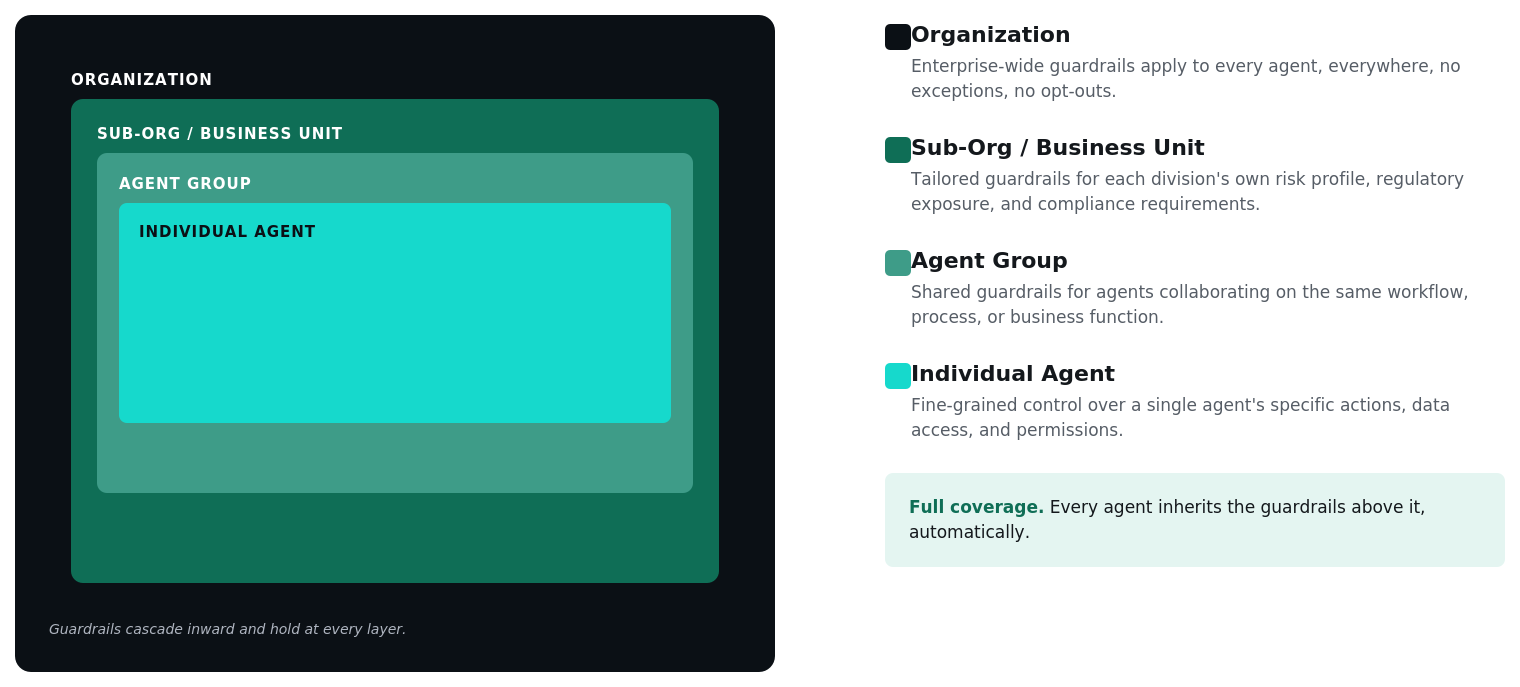
02 Define agent-specific guardrails and HITL policy. Inherit guardrails that cover groups of agents, workflows, business units, or org-wide, without gaps.
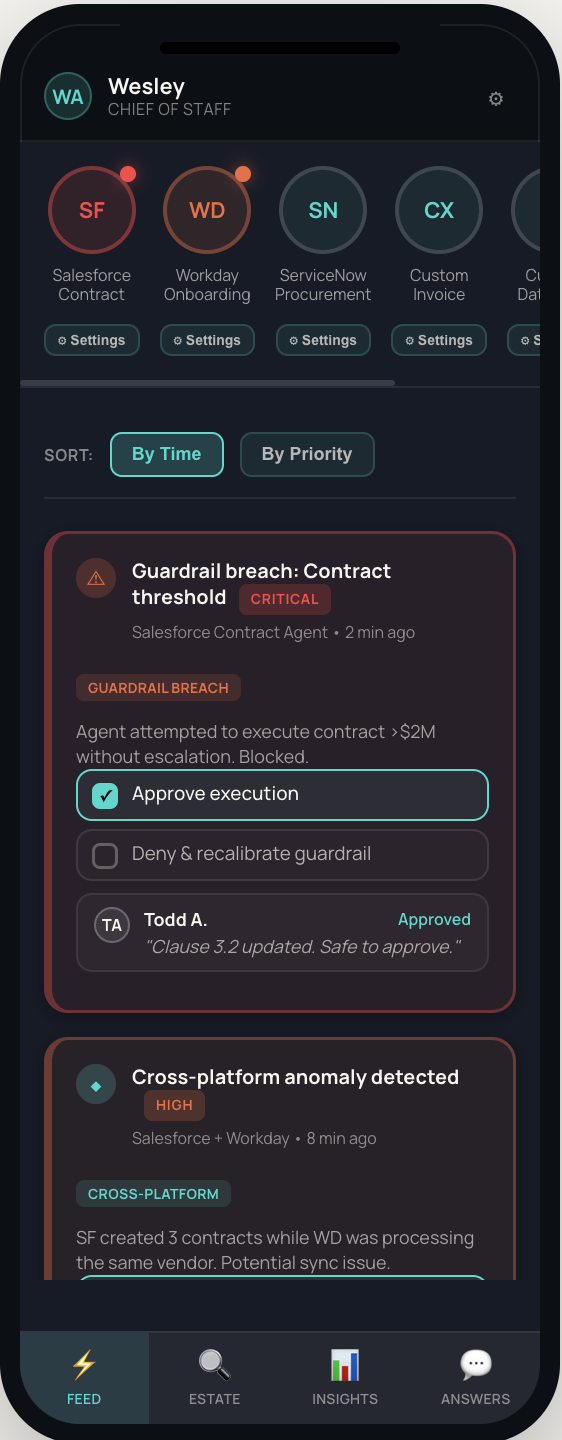
03 Human-in-the-loop and guardrail escalations are routed automatically and intelligently. ForceEquals sends each one to the right person, by expertise and authority, no custom code required.
04 Capture the reason behind every decision and denial, not just the outcome, then trigger the resulting action back across the agent portfolio it affects.
05 Capture, with full context, any resulting policy or process change, then cascade it automatically to every agent whose guardrails should reflect it, and correctly exclude the ones that shouldn't.
06 Track every decision, sign-off, override, and outcome, so oversight can move from blanket review to earned, evidence-based autonomy over time.
07 Give the business one place to operate, audit, and improve the whole portfolio, and to query it for any question, down to a single decision, transaction, or escalation, for any agent.
The seven scenarios below are that same mechanism meeting seven different starting points.
SEVEN STARTING POINTS
CASE 01 The Agentforce Sprawl [SALESFORCE AGENTFORCE + CUSTOM]
BEFORE: 14 agents run on Salesforce Agentforce, each with its own guardrails and its own place to escalate to. Alongside them, 2 custom agents built on Claude do similar work, but they're invisible to the Agentforce console entirely. Between all 16, decisions and actions happen in more than 20 different places, with no shared record of who decided what, or why.
AFTER: All 16 agents, native and custom, escalate into the same place. Each issue reaches the person with the right expertise and the right authority to act on it, and every decision leaves a record anyone can trace back later.
16 → 1 ESCALATION DESTINATIONS — consolidated into one governed layer spanning Agentforce and custom Claude agents
16 → 1 AGENT GUARDRAIL AND GOVERNANCE CONTROL — every agent, native and custom, governed under one policy layer instead of sixteen separate configurations
CASE 02 The Agent 365 Rollout [MICROSOFT AGENT 365 + CUSTOM]
BEFORE: 15 agents run on Microsoft Agent 365, split across four teams that each manage their own: Procurement, HR, a subsidiary with its own compliance rules, and Legal. 3 more custom forecasting agents run outside Agent 365 entirely. When Legal fixes a policy on its own agents, nothing tells the other three teams the fix exists. Six weeks later, a routine audit finds a procurement agent still running on the old rule.
AFTER: The same fix now reaches every agent that should have it, Procurement's, HR's, and Legal's, automatically and in one pass. The subsidiary's agents are left alone, correctly, since they run under their own separate compliance rules.
1 change → 6 agents, 2 skipped POLICY PROPAGATION — one Legal policy change reaches every agent it should, in a single pass
CASE 03 The Audit [SERVICENOW AI CONTROL TOWER + CUSTOM]
BEFORE: An external auditor flags a six-figure payment that got approved without the required manual review. Three ServiceNow agents and one custom risk-scoring agent outside ServiceNow all touched the transaction, and nobody can quickly explain how the approval happened. Reconstructing it takes a week: cross-referencing logs by hand, then tracking down an engineer who remembers roughly how the model worked eight months ago.
AFTER: The full decision trail for the transaction pulls as a single record, ServiceNow-native and custom agents alike, no manual reconstruction required.
1 week → 1 AI chat AUDIT RESPONSE TIME — from cross-referencing timestamps by hand to one query
CASE 04 The Scrappy Stack [13 VENDORS, NO PLATFORM]
BEFORE: 20 agents got built up one at a time across 13 different vendor tools. There's no shared login between them, and some of these tools don't even have a concept of escalation, they just act on their own. A customer with an open billing dispute gets their subscription canceled anyway, because the billing tool and the support tool had no way to share what each one knew.
AFTER: All 20 agents, no matter which vendor built them, now escalate and act through one system. When one agent flags something like an open dispute, every other agent that could act on that same account sees it too, before it turns into a mistake.
20 siloed agents, 13 vendors → 1 system PORTFOLIO CONSOLIDATION — one policy update reaches every agent that can trigger the same mistake
CASE 05 The Shadow Sprawl [CUSTOM / LLM-NATIVE]
BEFORE: Any team can build an agent on Claude and have it running the same afternoon. Nobody's counted them in a while, so the honest answer is somewhere between 30 and 50 agents. One of them, built by finance to speed up reconciliation, quietly starts pulling in customer PII it was never meant to touch, well outside what GDPR allows.
AFTER: The moment that agent goes live, it's visible. The PII issue gets caught right away and fixed within hours, long before it turns into an actual violation.
30–50 unknown agents → 100% known and controlled FULL PORTFOLIO VISIBILITY — plus 1 PII exposure caught instantly, corrected in hours
CASE 06 The State-by-State Patchwork [REGULATED, HIGH-STAKES]
BEFORE: 12 underwriting agents handle policies across every state, and every single one requires a human to sign off before it goes out. Each state updates its own rules on its own schedule. The problem is, every recommendation looks equally confident to the human reviewer, whether it's built on this week's rule or one that's already four days out of date. So the human just approves it. The sign-off exists on paper, but it isn't really checking anything.
AFTER: Every state update now applies only to the agents it should, whether that's 2 states or 44. And the human sign-off means something again: reviewers can see whether a recommendation is built on current policy or on something too new to fully trust yet.
100% manual sign-off → earned oversight OVERSIGHT MODEL — every agent starts at full human sign-off, then earns lighter-touch review, state by state, as its own track record of correct decisions builds, never as a blanket policy change
CASE 07 The Build vs. Connect Decision [DEVELOPER-BUILT, CONNECTS TO FORCEEQUALS]
BEFORE: A developer is asked to build 10 agents for a new automation project. The usual path means building guardrails, escalation, human approval steps, and change management from scratch, then testing and maintaining all of it, ten times over, by a 4-person engineering team that isn't made up of compliance experts.
AFTER: Instead, each agent just connects to ForceEquals. All 10 are operating under full governance the moment they go live, and engineering never had to write or maintain a single line of guardrail code. The business also gets the tools to manage agent performance directly: guardrail and policy tweaks, HITL interaction changes, escalation routing, decisions, and actions, so the system can be molded to work for and with the business, without pulling unnecessary developer time.
10 builds → 1 connection GOVERNANCE CAPABILITY — guardrails, escalation, HITL, and change management arrive the moment each agent connects, instead of being built and maintained ten separate times
NEXT STEP
Whichever one sounds familiar, that's the one worth a conversation.
Different platforms, different industries, different scale, same underlying mechanism: connect, inherit governance, cascade corrections, earn oversight over time. ForceEquals governs above the platform, so it doesn't matter which one, or how many, you're running.
Each of these is just one example. Some may resonate immediately. Others may show up as a combination you're already living, one issue, several at once, or all of them at the same time, spread across your agent portfolio. ForceEquals simply and elegantly solves all of these, and the thousands of other case types that surface the moment you start deploying more agents into your workflows.
Marc Chabot — Co-Founder & CEO, ForceEquals
marc@forceequals.ai · forceequals.ai
Lakshit — Co-Founder & CTO, ForceEquals
lakshit@forceequals.ai · forceequals.ai