
You Have Multiple AI Agents Now. Your Guardrails Still Think You Have One.
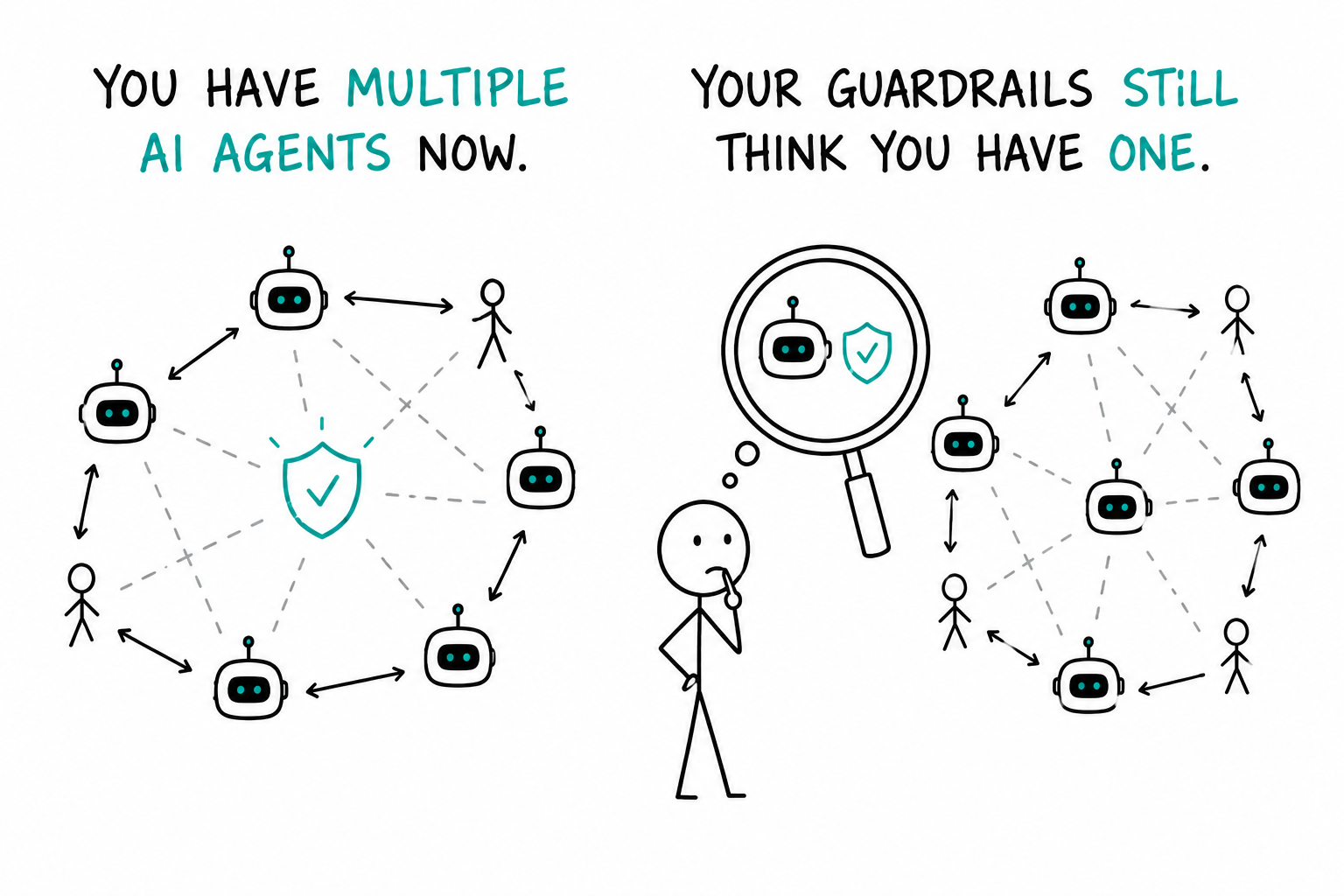
Agentic AI best practices for how to organize and design AI guardrails, and which tools you need for multi-agent architectures and multi-agent AI portfolios.
Most teams write their first ai agent guardrail the same way: a rule attached to a single agent. Don't approve refunds over $2,000. Don't touch a customer's billing address without a second check. That rule works. It gets tested against real transactions, it fires when it should, and it earns the team's trust.
Then a second agent gets added. Then a third, handing work to the first two. The team keeps doing what worked: write another agent-level rule for the new agent, copy the pattern, move on. This is where it breaks, and most teams don't notice until something has already gone wrong. A guardrail approach built for one agent at a time doesn't scale by addition. It has to change shape entirely once agents start handing work to each other, and almost nobody updates it when that moment actually arrives.
That shift, not the number of agents itself, is the real problem. It's also a problem with at least four levels, and most teams are only working at one of them.
An agent doesn't operate alone. It works inside a group of agents that hand off tasks to each other. That group supports a business function like finance or support. That function is one piece of an org that has its own risk tolerance, compliance obligations, and blast radius if something goes wrong. Write guardrails only at the agent level and you've governed the smallest, least dangerous part of the system. The bigger risks live in the layers above it, where nobody wrote a rule at all.
Here's how to actually fix that, in order:
- Get the anatomy of a single guardrail right. Every level above it is built from the same five parts, so this is the foundation the rest depends on.
- Understand why a rule designed for one agent doesn't hold once agents hand off work to each other. That shift is the thing most teams miss.
- Walk up the four levels themselves: the agent, the group of agents it hands off to, the business group that group serves, and the org that business group sits inside.
- See why writing rules at the right level, not just the agent level, is what lets a single policy change reach every agent it should and none that it shouldn't.
- Deploy it in a purpose-built Agent Control solution built exactly for this, instead of trying to bolt group, business, and org-level enforcement onto tooling designed to watch one agent at a time.
- Operationalize the change. This isn't set-and-forget. Policies drift, agents behave in ways nobody predicted, and ambiguity shows up slowly at first and then every day. Your team needs a way to see every escalation across every level in one place, so you can tell exactly when a rule needs updating instead of finding out after it already failed.
By the end, you'll have a way to decide, for any new rule, exactly which of the four levels it belongs at, and why writing it there instead of at the agent level is what makes the business fast to change instead of slow to trust.
Before going further, it's worth defining the term, since people search for it a few different ways: guardrails for AI, guardrails in AI, AI guardrails, guardrails AI. They all mean the same thing. What are AI guardrails, concretely? They're the conditions, thresholds, and escalation paths that decide when an agent's output needs a human, a hard stop, or a specific alternate action instead of just running unchecked. In a multi-agent architecture, that definition doesn't change. What changes is how many places a guardrail has to live.
Start with what a single guardrail actually needs
Before scaling guardrails up a level, get the basic unit right. A rule that works has five parts:
A trigger stated as a condition, not a feeling. "Flag anything risky" isn't a rule. "Flag any refund over $2,000" is.
A failure mode it belongs to: a hard boundary broken, an anomaly against historical pattern, ambiguity the agent can't resolve on its own, or a strategic signal worth a human seeing even at low risk. Each needs a different response, so don't collapse them into one generic alert.
An owner and an action. A guardrail with no named human and no defined next step is a log line, not a control.
A threshold set in the rule, not in someone's head. "Escalate if confidence is low" isn't a rule. "Escalate if confidence is below 80%" is.
A version. Agents change, rules drift, and if you can't tell which version of which rule fired on which version of which agent, you can't debug an incident weeks later.
That's the foundation. Multilevel guardrails are the same five parts, applied at four different altitudes.
Level 1: The agent
This is where most guardrail effort still lives, and for good reason. It's the most concrete level. A single agent has a defined job, a defined set of tools, and a defined blast radius if it acts wrong. Rules here look like the refund example: specific thresholds, specific actions, specific escalation paths tied to what this one agent is allowed to do on its own.
The mistake isn't writing agent-level rules. It's assuming they're sufficient.
Now that you have more than one AI agent, you need a different approach for guardrails
The instinct once you have a portfolio is to write a good agent-level rule and copy it across every agent. That instinct is wrong, and it's worth being specific about why, because the difference is what makes levels two through four necessary instead of optional.
A single agent's guardrail only has to be right about that agent. You know its inputs, its tools, and the full range of actions it can take. You can test a rule against a real transaction and know whether it fired correctly. None of that holds once a second agent enters the picture.
Violations become emergent instead of local. Three agents can each stay inside their own individual rule and still produce an outcome none of the three individually caused. Agent one classifies a request correctly. Agent two acts on a correct classification with stale context. Agent three executes on what agent two handed it, also correctly, given what it was told. Nobody broke a rule. The chain still produced a bad outcome, and no agent-level guardrail was ever positioned to catch it.
Context decays across handoffs, and rules don't know it. A guardrail written for agent three assumes the context it receives is accurate. It usually has no way to check whether that context was still correct three steps upstream, or whether something changed between when agent one gathered it and when agent three acted on it. Single-agent design doesn't have this problem because there's no handoff to decay.
Order and timing change the risk, even with identical agents. The same three agents running in a different sequence, or running the same sequence but faster than a downstream system expects, can produce a different risk profile from an identical set of individually-passing rules. A guardrail designed around one agent's behavior has no concept of sequence at all, because there's only one step to sequence.
Confidence compounds instead of standing alone. An agent that's 90% confident handing off to an agent that's 90% confident on top of that isn't a system that's 90% confident. Confidence multiplies across a chain, it doesn't average: 0.9 × 0.9 = 0.81. Two handoffs at 90% each leave you with a system running at 81% end-to-end reliability, already lower than either agent's own number. Add a third 90%-confident step and it drops to roughly 73% (0.9³). Nobody's dashboard shows that number, because each agent is still correctly reporting its own 90%. Single-agent guardrails are built around a threshold on one number. Multi agent guardrails need to account for a number that degrades as it passes through the chain, and a rule set at 80% for one agent can still be sitting on top of a chain that's actually running well below that once you multiply it out.
Attribution gets harder exactly when it matters most. When a single agent fails, the postmortem is straightforward: look at that agent's inputs and outputs. When a chain of agents produces a bad outcome, the question of which step actually caused it, versus which step merely passed along a problem it inherited, requires guardrails designed to preserve that lineage from the start. Bolt this on after the fact and the trail is already gone.
None of this means single-agent rules are wrong. It means they're necessary but not sufficient, and the gap between "necessary" and "sufficient" is exactly where levels two through four have to live.
Level 2: The group of agents
Once agents hand off work to each other, guardrails have to cover the handoff, not just the individual steps. An agent that pulls customer data, hands it to a second agent that drafts a response, which a third agent sends, creates a chain where each individual step can pass its own rule while the sequence as a whole produces a bad outcome.
This is where the math starts to matter, and it's the reason multi-agent architectures can't run on agent-level guardrails alone. Ten agents in a group produce roughly 45 possible interaction points. A hundred agents produce close to 5,000. Guardrails at this level aren't about any one agent's behavior. They're about whether the context passed between agents stayed accurate, whether a decision made by agent one still holds by the time agent three acts on it, and whether an anomaly across the group, not any single agent, should trigger a human check.
Write these as group-level rules explicitly, not as a restatement of what each agent already checks on its own. Take a claims-processing group in insurance: an intake agent extracts the claim details from the filing, an adjudication agent decides payout eligibility, and a payment agent issues the payout. Each has its own agent-level guardrail and each can pass its own check individually. Now say, on one specific claim, the intake agent flags a low-confidence read on the incident date, the adjudication agent flags that the claimed amount is an outlier against similar claims, and the payment agent flags that the payee account was only added to the policy this week. No single one of those escalations is necessarily disqualifying. Together, on the same claim, they're a pattern no individual agent can see, because none of them has visibility into what the other two just flagged.
That's a group-level rule: "If more than two agents in this claim's workflow escalate within the same process instance, halt and route to a human adjuster before payment is issued." It doesn't exist at the agent level because writing it there would mean giving every agent visibility into every other agent's output just to check a condition that only makes sense once at the group.
Level 3: The business group
A group of agents usually serves a function: collections, underwriting, support tier one, procurement. At this level, guardrails stop being about individual actions or handoffs and start being about whether the agent portfolio, taken together, is staying inside the function's actual risk tolerance.
This is where volume and pattern rules live. Not "did this agent approve one bad refund" but "has the refund approval rate for this business unit moved outside its normal range this week." Not "did this agent send one strange message" but "has the tone or content of customer communications from this function shifted in a way that suggests a prompt, a model update, or a data source changed underneath it."
Business-group guardrails need their own owner too, usually someone above the individual process, because the fix at this level often isn't "correct this one agent." It's "something changed in how this whole function operates, and it needs a decision, not a patch."
Level 4: The org
At the top, guardrails stop being about any specific workflow and become about the enterprise's overall exposure. Compliance obligations that apply across every business unit. Data handling rules that no individual agent or group should ever be able to violate, regardless of which platform built them. Aggregate risk: if every business unit is independently within tolerance but the sum of what all of them are doing together crosses a line the org can't absorb, someone needs to see that before it becomes an incident.
This is also the level where platform boundaries stop mattering and start being a liability. An org running agents across Salesforce, ServiceNow, Microsoft, and custom code has org-level exposure that spans all of them. A guardrail that only watches one platform's portfolio can't see it.
Why most teams stop at level one
Writing a guardrail for a single agent is tractable. You can see the agent, its tools, its inputs and outputs. Writing a guardrail for a group, a business function, or an org requires visibility that doesn't exist in most stacks, because each platform governs its own agents and stops at the edge of its own portfolio. Nobody's ignoring levels two through four on purpose. Most teams simply don't have anywhere to write those rules, because no single system sees across the whole portfolio to enforce them.
That's the gap ForceEquals is built to close. It's governance for AI agents that sits above the individual agent platforms and frameworks, not inside any one of them, so guardrails can actually be written and enforced at the group, business, and org level, not just the agent level where the tooling happens to already exist. AI agents governance that stops at the edge of one platform isn't governance at the portfolio level at all, and portfolio level is where most of the real risk lives. Escalations from any level feed the same Continuous Transformation Loop: govern, escalate, decide, act, learn, deploy, repeat, so a pattern caught at the org level can turn into a new rule at the agent level, and vice versa.
Writing the rules at the right level is Agent Control. Living with them afterward, watching every escalation land in one place, and catching the drift before it becomes an incident, is Agent Operations. Guardrails aren't a project you finish. They're a loop someone has to run, and that's what step six is actually asking a team to commit to.
The payoff: change once, apply everywhere it should
Here's what levels actually buy you, beyond just organizing the problem. Write a rule at the group level and it applies to every agent in that group automatically. Change the threshold, tighten a trigger, add a new failure condition, and every agent inheriting from that group picks it up without anyone touching each agent one by one. Write a rule at the agent level instead, and it stays exactly where you put it. Only that agent behaves differently.
That's not a limitation. It's the point. A rule that belongs to every agent in collections should live at the collections level, so a policy change propagates the moment it's made instead of needing forty individual edits and forty chances to miss one. A rule that's specific to a single agent, because that agent alone touches a particular tool or handles a particular exception, should stay right there, so tightening it doesn't ripple into agents that have nothing to do with the exception you're actually managing.
This is what makes the level a design decision, not just a category label. Get it wrong and you end up in one of two bad places: editing the same rule forty times because you wrote it at the agent level when it belonged to the group, or watching a rule change hit every agent in a business function because you wrote it at the group level when it should have stayed local to one. Get it right and the business gets something it didn't have before: the ability to manage nuance and change at exactly the scope the change actually applies to, instead of either too broad or too narrow every time.
Here's what that looks like in practice. Say an org is running 100 agents across four business divisions. Legal updates a policy that applies to three of those divisions and doesn't apply to the fourth, maybe a regional carve-out or a product line with different regulatory treatment. In ForceEquals, that policy lives at the level of the three affected business groups. One change there, and every agent inheriting from those groups, somewhere around 65 to 75 agents depending on how they're distributed, picks up the new rule automatically. The fourth division's agents inherit from a group the change was never applied to, so they correctly keep running the old policy without anyone having to remember to exclude them.
The alternative is going into 65 or 75 individual agents by hand, updating the same policy in each one, and hoping every single edit landed correctly and nobody missed one or updated an agent in the fourth division by mistake. That's not a hypothetical failure mode. It's what happens by default when guardrails are only ever written at the agent level, and it's exactly the gap that writing rules at the right level, group instead of agent, closes.
The rule of thumb
If you can write a guardrail and test it against a single transaction, it's an agent-level rule. If you need to look at a sequence of agent actions to know whether it fired correctly, it's a group-level rule. If you need a week of data across a whole function to know if it's working, it's business-group level. If the answer depends on aggregating across functions and platforms, it's an org-level rule, and it needs a system built to see across all of them, which is the specific gap ForceEquals sits in.
Guardrails at one level protect one thing. AI guardrails at four protect the business.