
How To Build A Continuous Transformation Loop
How To Build A Continuous Transformation Loop
Here's the brutal truth: most organizations trying to implement continuous transformation are failing because they're missing one critical piece.
Organizational change requires three things to align: mindset, skillset, and toolset.
Most transformations focus on mindset—motivational speeches, change talks, "embrace innovation" messaging. Mindset matters. But without the right toolset, mindset has nowhere to live. Without toolset, skillset develops slowly if at all.
The company that gets all three wins. The companies that get one or two get stuck.
The Three Pillars
Mindset means operating from assume you're wrong, try to be less wrong. See guardrail breaches as signals, escalations as questions. This is the Elon framework we discussed in the previous post. Most companies have this as aspirational poster material, not operational reality.
Skillset means learning to ask better questions. Investigating why an agent broke a rule. Running experiments. Capturing learnings. Recognizing patterns in escalations—which are outdated assumptions and which are genuine risks. This skillset develops slowly without infrastructure to support it.
Toolset is the infrastructure that makes the loop operational at scale. Seeing every agent. Seeing every decision. Understanding escalations. Capturing what changed and why. Connecting escalations to outcomes. Making learning impossible to avoid.
Here's the problem most enterprises have: they invested in mindset (change management programs), maybe some skillset (training), and then realized they need a toolset. So they try to bolt on governance after the fact. They've already deployed agents, built workflows, automated decisions. Now they're trying to figure out which decisions need approval, which need visibility, which need audit trails.
This doesn't work. The architecture needs to be built in from the start.
What It Actually Looks Like
Let me show you a real example of how this works.
A logistics company starts with one autonomous system optimizing delivery routes. Month one: 3% reduction in fuel costs. Useful.
The system surfaces something unexpected: certain zones have different delivery patterns. An agent tries same-day delivery in high-density areas. Not in standard policy. Guardrail breach. Escalates.
Here's where most companies fail: they lock it down. Build more rules. Require more approvals.
Here's where the winning companies go: they ask the right question. Why is the agent trying this? What does it see? Investigation reveals the agent is right. Same-day delivery works there. That wasn't a breach. It was an insight. They update policy. Month two: new revenue stream unlocked.
Six months in, escalations have become their best source of ideas. Every time the system hits a guardrail, it's asking a question: is this rule still true? Some escalations reveal outdated policies. Some reveal genuine risks needing tighter controls. Some reveal new business opportunities hidden in data. Escalations stop being failures and become learning loops.
By month nine, escalation patterns reveal something fundamental about the business. The company is less wrong about operations than nine months ago. Understanding evolved. Processes evolved. Capabilities evolved. They're asking better questions about what's possible.
A larger competitor seeing the same opportunity responds with tighter approvals and gatekeeping. They're trying to prevent surprises instead of learning from them. By the time they convince themselves same-day delivery is safe, the smaller company owns the market.
The difference isn't intelligence. It's infrastructure. One company had the systems and discipline to ask questions continuously. The other company defaulted to prevention.
The Core Problem
Here's why most enterprises fail at this: they have no single place to see what their agents are doing, or how that connects to operations, escalations, guardrails, and changes actually running their business.
They have agents everywhere. Autonomous workflows. Multiple systems making decisions. But no unified view. No coordinated governance. No single source of truth.
That's where you lose control. That's where you miss signals. That's where learning dies.
Without this, continuous transformation is impossible. You can't capture signals if they're scattered across systems. You can't route escalations if you don't see them. You can't learn if you don't track outcomes.
How ForceEquals Enables All Three
ForceEquals was built on one insight: agents identify problems faster than humans, but agents alone aren't the answer. Neither is human judgment alone. The combination—agent speed feeding human judgment at scale, continuously—is everything.
ForceEquals is one system that governs every agent. It shows you what's happening in real time: every decision, every escalation, every breach, in one place. It routes escalations to the right human with full context. Not approvals for everything. Just the decisions that matter. It drives the changes required to keep your agent estate operating as intended.
Here's what becomes possible:
- You see escalation patterns never visible before. Why are these decisions always escalating? What's the system telling you?
- You understand which breaches are risks and which are opportunities. A vendor rule that's consistently breached isn't a security problem—it's a strategy question.
- You capture outcomes from every change and learn what actually works. Did that policy evolution work? What did we learn? This becomes the next set of ideas.
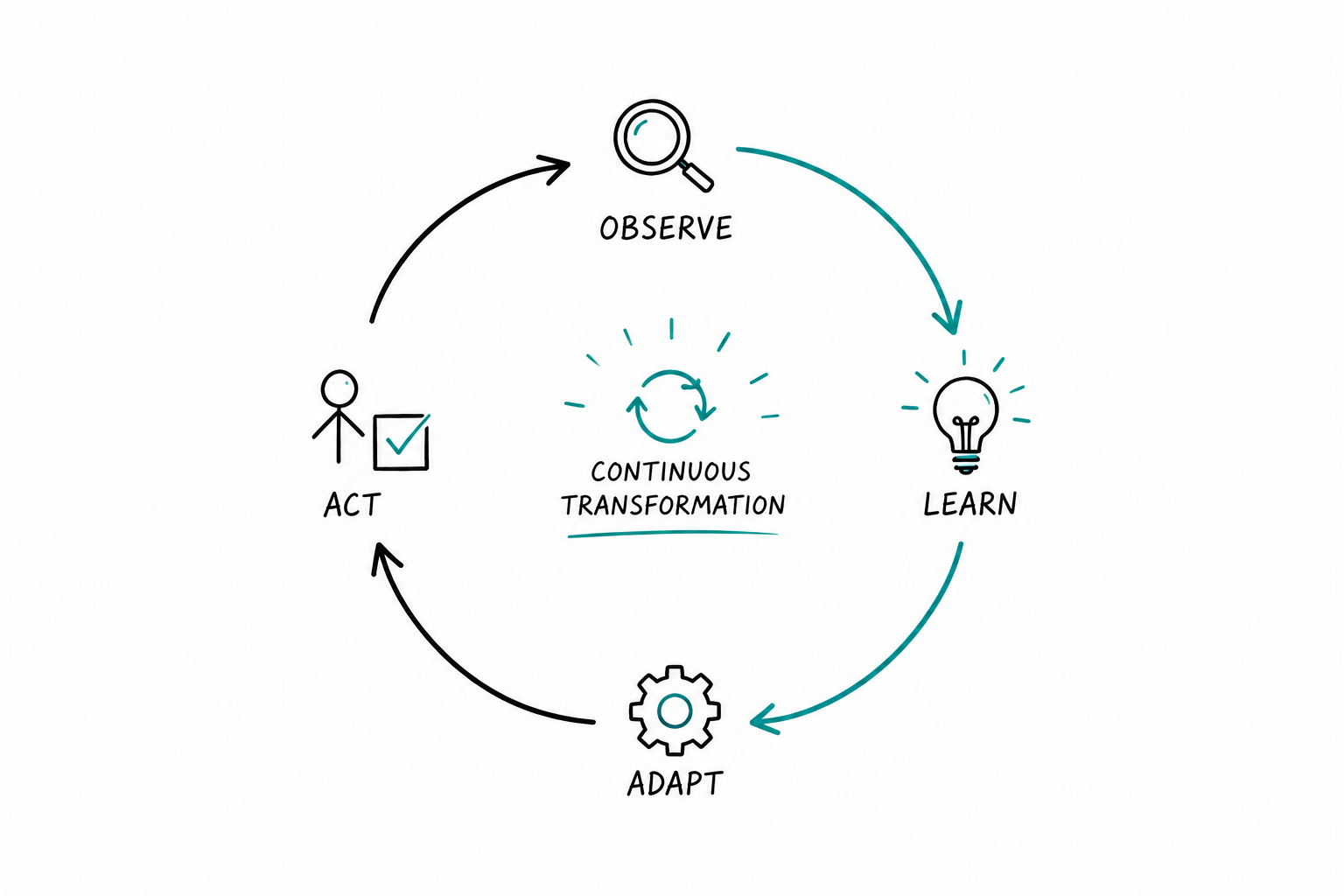
- The Elon loop completes: new questions emerge from escalations → you test → you gain a better understanding of the truth → better questions → loop back.
Without ForceEquals, the three pillars can't align. Your mindset shifts (assume you're wrong), your team learns the skillset (ask better questions), but your toolset is inadequate. You're still capturing signals manually. You're still routing escalations through email. You're still tracking outcomes in spreadsheets.
With ForceEquals, all three pillars work together. Mindset, skillset, and toolset operate as a system. And that system is how you build continuous transformation.
Getting Started
Here's what this looks like in practice:
- Connect your AI agents. ForceEquals becomes the central nervous system for your agent estate. Every agent reports into one place. You're no longer flying blind with agents scattered across systems and siloed in different tools.
- Start small. Pick one autonomous workflow. Make it visible through ForceEquals.
- Track escalations. Every escalation is a learning opportunity. Treat it like data.
- Implement the questioning posture. This is where executives lean in. When an escalation happens, don't default to locking it down. Ask questions at every level:
- Agent level: Why did this agent try to break the guardrail? What decision did it want to make? What was it seeing?
- Group level: When multiple agents hit the same guardrail, is there a pattern? Are they all seeing something we're missing? Is this guardrail outdated?
- Organizational level: What do these escalation patterns tell us about how the business actually operates versus how we think it operates? Are our policies aligned with reality?
- This isn't a compliance team activity. This is a C-suite conversation. The CFO asking why procurement agents keep trying to buy from certain vendors. The COO asking why scheduling agents keep wanting to work around labor rules. The CIO asking what patterns are emerging across the agent estate. This is how you learn faster than the market moves.
- Capture outcomes. This is where ForceEquals becomes the engine of continuous transformation. It doesn't just track what changed—it systematizes the entire learning cycle:
- Captures new ideas: Every escalation, every guardrail breach becomes a potential idea. ForceEquals surfaces them automatically.
- Compares to strategy: Automatically evaluates ideas against your strategic priorities. Which opportunities align with where you're trying to go?
- Prioritizes impact: Ranks ideas by potential impact and feasibility. What will move the needle fastest?
- Enables alignment: Brings the right stakeholders together with full context. No confusion. No siloed conversations. Everyone sees the same data.
- Drives rapid deployment: Once aligned, helps you plan and execute in days, not months. The idea moves from escalation to impact quickly.
- Tracks the outcome: Measures what happened. Did it work? What did we learn? This becomes the next set of ideas.
- Without ForceEquals, this all happens manually. Spreadsheets. Email threads. Meetings about meetings. With ForceEquals, it's systematic, fast, and continuous. Every week, you're learning something new.
- Scale. As you understand the pattern with one workflow, add another. Then another. Each one feeds the same system.
Over time, the organization develops the muscle. The mindset becomes operational. The skillset becomes natural. The toolset becomes invisible because it's just how work happens.
That's when you hit continuous transformation. That's when you compound.
The next part of this series shows why smaller companies are about to own the market. Spoiler: it has to do with who can actually build this first.
Ready to build your continuous transformation loop? Learn how at forceequals.ai.
This is Part 2 of a 5 Part series. Links to all below.
Escalations Are Signals, Not Failures
How To Build A Continuous Transformation Loop
The Jevons Paradox Is Your Biggest Opportunity
Assume Your Wrong, Try To Be Less Wrong