
The Math of Continuous Wins
The Math of Continuous Wins (And Why Your Competitors Understand It)
This isn't just strategy. It's mathematics, and the stakes are brutal.
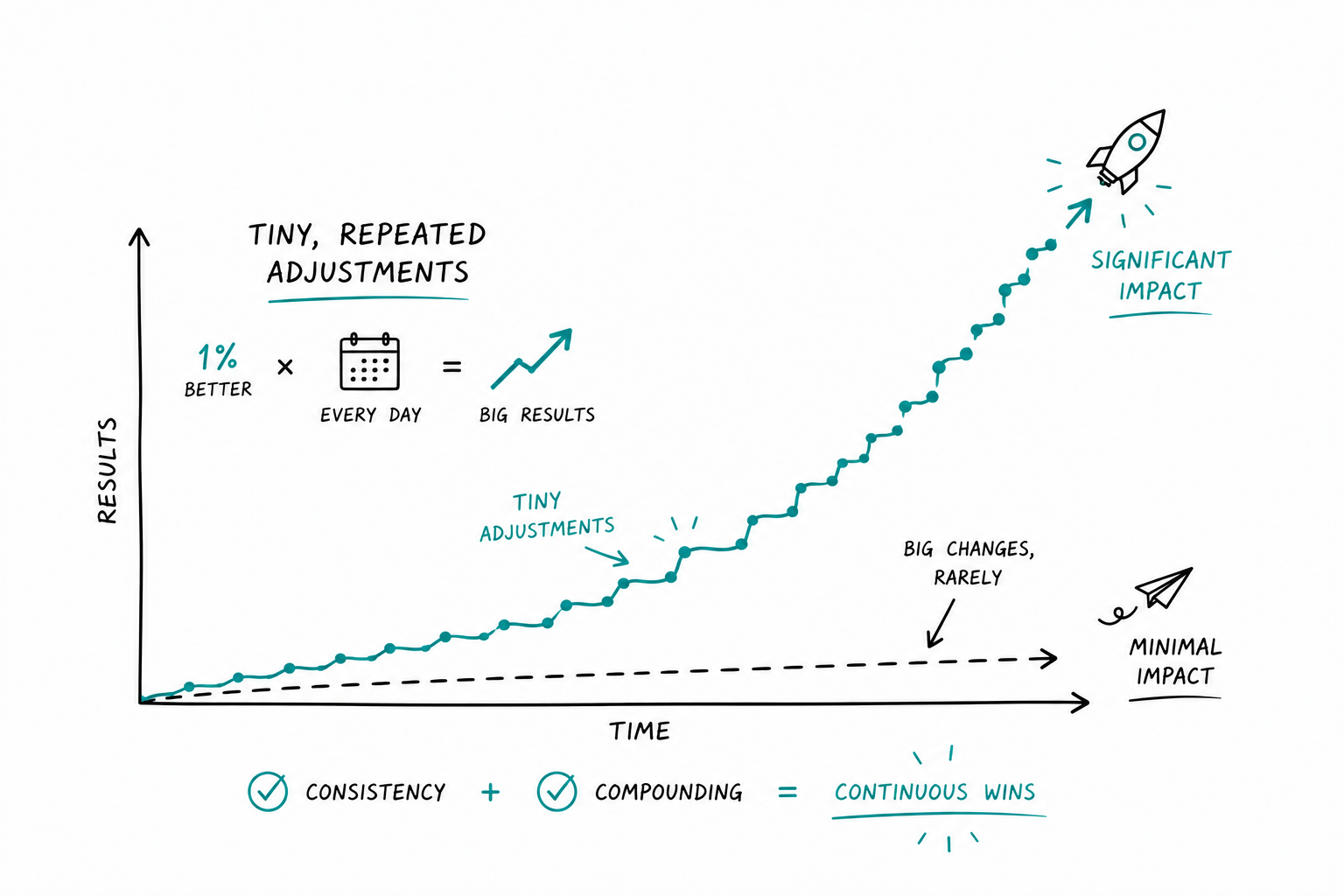
A company doing continuous transformation achieves 1% improvement per day. Small changes. Fast feedback. Learning every week. Over one year, that's 1.01^365 = 37.78x improvement.
Over five years, it's 6,000x improvement.
A company doing big bang projects achieves 100% improvement once. They double their capability in a massive transformation project. Then they plateau. Eighteen months later, they do another 100% improvement project. They double again.
By the time they've done three big bang projects (hitting 8x improvement), the continuous company is at 6,000x.
It's not close. It's not even in the same league.
The Problem With Projects
Most enterprises think in projects. You run a transformation initiative. It takes six to eighteen months. You launch. You move on. The next project starts in two years.
Three projects over six years: 2x → 4x → 8x improvement.
A continuous transformation company over the same six years: 37.78x improvement, compounded twice = 1,427x improvement by year six.
This isn't a competitive disadvantage. This is existential.
Making It Tangible
Here's what people don't understand about continuous transformation: it doesn't require genius agents or breakthrough insights.
If you have 100 agents running continuously, how many insights does each agent need to surface to hit 1% daily improvement? Not thousands. Not even hundreds per agent. Each agent needs to surface roughly one insight per month. One small improvement, one signal about what's not working, one discovered opportunity. That's it.
With 100 agents surfacing one insight per month, that's ~8 improvements per week. Compounded daily, that's 1% improvement per day. Compounded annually, that's 37.78x.
The math is simple: small signals from many agents, captured and acted on continuously, compounds into dominance. You're not looking for breakthroughs from each agent. You're looking for continuous small signals that compound when scaled across your agent estate.
This is why the gap compounds every quarter. This is why the companies that figure out continuous transformation don't just win—they own their markets. It's not because they're smarter or have more capital. It's because they're in a completely different mathematical reality.
Small changes that compound beat one-time improvements that plateau every single time.
Why This Matters Right Now
If your competitor understands this math and you don't, the clock is ticking.
They're not looking to be 20% better than you. They're not aiming for 2x improvement. They're building for exponential advantage. By the time you realize you're behind, they're already at 100x+ your capability.
And here's the thing: they're not waiting for quarterly planning cycles or annual budgets. They're moving weekly. Every improvement gets captured, every signal gets acted on, every outcome gets measured. By the time your team gets approval for your next project, they've already compound 52 times.
The companies that understand this math are already moving. They're already building the infrastructure to capture those daily 1% improvements. They're already establishing the competitive moat that will be unbreakable in three years.
How ForceEquals Makes It Possible
The math only works if you can actually capture those continuous signals and act on them fast. Most companies can't. Their escalations disappear into email. Their innovations get stuck in approval cycles. Their learning never happens.
ForceEquals is built specifically to make this math real. It captures every escalation. It routes signals to the right humans instantly. It tracks outcomes from every change. It systematizes learning so that each week, you're genuinely 1% better than you were the week before.
Without a system like ForceEquals, continuous transformation is a nice idea. With it, the math becomes inevitable. You hit 1% daily. You compound to 37.78x annually. You own your market in five years.
Your competitors understand this. The question is: do you?
The next part of this series explores the thinking framework that makes continuous transformation possible. Hint: it starts with "assume you're wrong."
Ready to understand how ForceEquals enables this math? Learn more at forceequals.ai.
This is Part 4 of a 5 Part series. Links to all below.
Escalations Are Signals, Not Failures
How To Build A Continuous Transformation Loop
The Jevons Paradox Is Your Biggest Opportunity
The Math of Continuous Wins
Assume Your Wrong, Try To Be Less Wrong