
The Jevons Paradox Is Your Biggest Opportunity
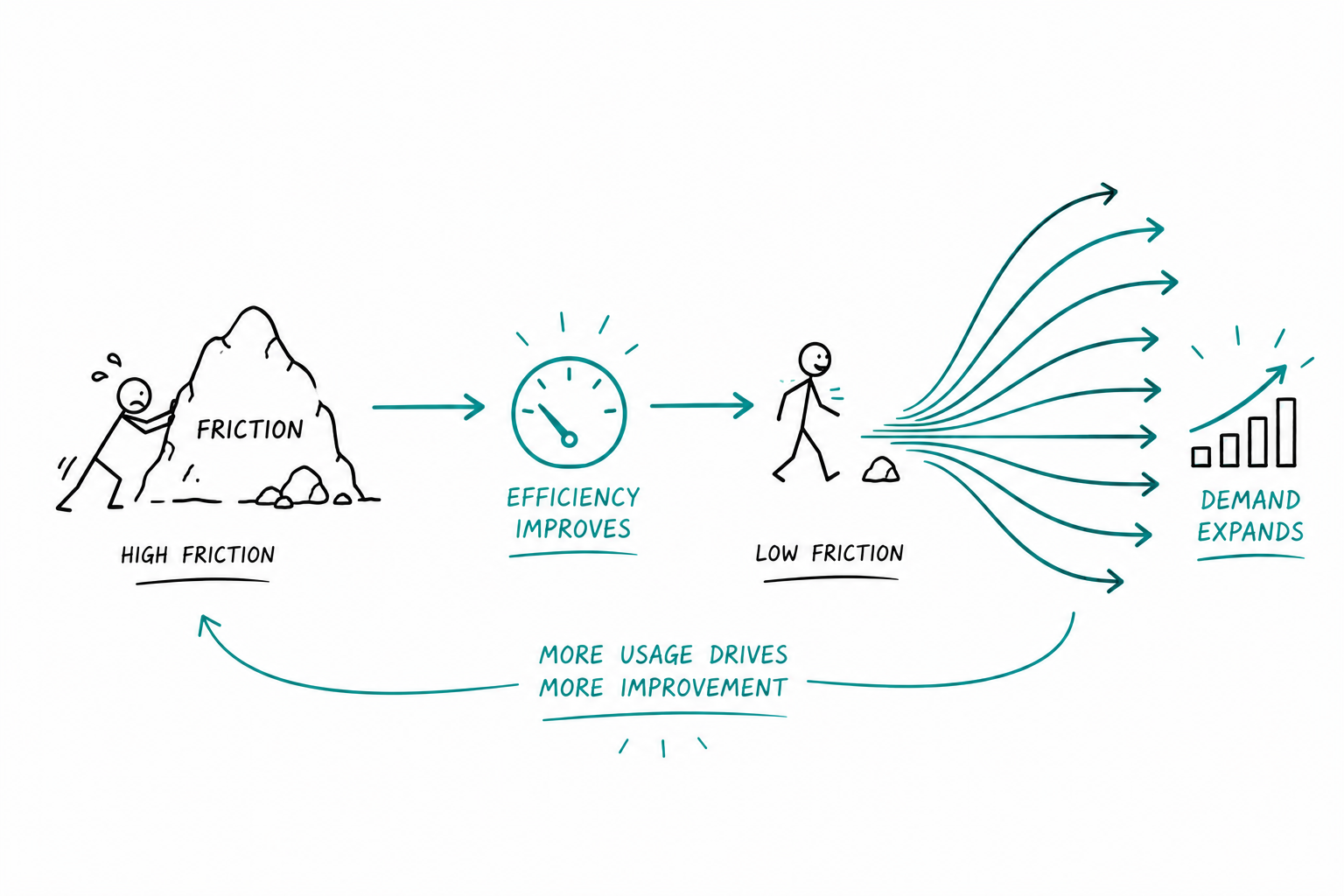
The Jevons Paradox Is Your Biggest Opportunity: How AI Reveals What's Possible
Every use case you solve with AI surfaces ten more.
This isn't a problem. It's the biggest opportunity AI presents.
Solve procurement, and you discover you can optimize vendor selection more deeply. Then logistics becomes interesting. Supply chain patterns emerge. Then customer behavior prediction. Each problem solved opens five new ones. This is the Jevons paradox applied to AI: the more AI-enabled you become, the more transformation opportunities appear. The frontier advances daily.
Most companies don't realize they're sitting on a goldmine. They see the escalations, the guardrail breaches, the exceptions, and they lock things down. They prevent. They control. They miss the opportunity that's staring them in the face.
But the smart companies—the ones that understand what's actually happening—see this as an opening. Every escalation is a chance to learn something new. Every agent trying to break a rule is surfacing an opportunity to do something better.
The companies that capture this opportunity will own their markets. The ones that don't will watch competitors move past them.
The Real Advantage
Here's what most companies miss: agents identify problems and opportunities faster than humans ever could. That's not a threat. That's the entire point.
When you combine agent speed with human judgment, you transform continuously in small increments. You compound advantage. You beat the old human-centric approach by an order of magnitude.
The companies that recognize and enable this will win. The ones that don't will watch their markets move. An enterprise needing six months per improvement is already behind. An incumbent needing a strategic review to explore a capability is losing. A company that can't act on opportunities because they don't fit next year's budget is leaving money on the table.
Meanwhile, a smaller company sees an opportunity Monday, tests it Wednesday, scales it the next week. That's exponential advantage. Not from smarter people or more technology. From actually being able to capture and act on every opportunity that emerges.
This is the world we're entering. George Sivulka nailed it: "Ongoing AI transformation efforts may become the only way to compete." Every competitor hunts for the next opportunity. The companies that answer quickly compound advantage.
A manufacturing company doesn't just optimize scheduling once. It optimizes, then predicts maintenance, then predicts quality issues, then renegotiates supplier terms, then discovers it can serve an entirely new market segment. Each step triggers the next. Each insight unlocks the next opportunity. The company moving in projects never gets past step two before the fiscal year resets the agenda. The company moving continuously captures all of it.
Why Enterprises Miss It
Here's the painful truth: most enterprises have stopped asking questions. They know how procurement works. They know how fulfillment should happen. Why question it? Why look?
But AI changes that equation. Autonomous systems reveal edge cases and try decisions that violate old rules. Some companies see this as a threat to prevent. They lock things down and suffocate their ability to capture new opportunities.
Other companies see it as a frontier to explore. They learn faster than the market moves. They ask: why did the agent try that? What opportunity is it seeing? And suddenly, they're moving into new markets, new capabilities, new revenue streams their competitors haven't even imagined.
The real challenge isn't scale or complexity. It's organizational velocity. A large organization confident in its processes requires enormous energy to question those processes. By the time that energy arrives, the market has moved on. A smaller company with no investment in "this is how we do things" can ask better questions, explore faster, and capture opportunities the incumbents miss.
But here's the secret: size doesn't determine speed. Infrastructure does. The enterprise that builds the right infrastructure to capture opportunities continuously can move just as fast as a startup. Faster, actually, because they have scale and resources.
The Opportunity
This is the inflection point. AI doesn't just automate tasks. It reveals what's possible.
Every escalation is a signal that your agents are seeing something valuable. Every guardrail breach is an opportunity to discover something new. Every exception is a frontier waiting to be explored.
The companies that build infrastructure to capture these signals—to investigate them, to learn from them, to act on them—will transform faster and own their markets.
The companies that lock things down and prevent change will slowly degrade against competitors who actually explore what's possible.
The good news: this is entirely within your control. It's not about having smarter people or more capital. It's about building the systems to capture what your agents are revealing, and the discipline to act on it.
How ForceEquals Changes The Game
Most companies will default to control mode. Lock things down. Prevent surprises. Move slower. Gradually become irrelevant.
The companies that want to capture this opportunity need something different. They need infrastructure that makes continuous transformation operational.
ForceEquals was built specifically for this. It's the complete infrastructure for capturing and acting on every opportunity your agents surface.
Here's the full cycle:
Control and Sensing: ForceEquals provides Agent Control across your entire agent estate. It establishes multilevel guardrails across all your agents—not just binary yes/no rules, but nuanced policies that reflect reality. And it's system agnostic, so whether your agents live in your native systems, third-party platforms, or a mix of both, you have one unified infrastructure that both controls agent behavior AND senses opportunities in one place.
Escalations and Routing: Every guardrail breach, every exception, every signal gets surfaced automatically. One place for all escalations to humans. One solution to route to the right human with full context and decision authority. No more emails disappearing. No more signals getting lost.
Capture and Learning: ForceEquals automatically captures every decision, every action, every outcome. What changed? Why? What was the result? This becomes data, not tribal knowledge.
The Flywheel Loop: Every escalation feeds through the flywheel. Opportunities to improve and change are automatically identified and sent through the cycle. Combine with your strategy. Prioritize by impact. Align stakeholders. Plan deployment. Deploy fast—weeks instead of months.
And it loops back. Every outcome feeds the next escalation. Every escalation surfaces the next opportunity. Every opportunity becomes the next learning.
The enterprise that deploys ForceEquals first—the one that decides to explore rather than prevent—will capture opportunities their competitors don't even know exist. They'll move into adjacent markets. They'll discover new capabilities. They'll compound advantage while competitors are still debating whether it's safe.
The Jevons paradox isn't eating enterprises. It's offering them the biggest opportunity AI has ever presented.
The question is: are you going to capture it, or prevent it?
The next part of this series explores the mathematical reality of capturing these opportunities continuously. Spoiler: the numbers are staggering.
Ready to capture the opportunity? Learn how ForceEquals enables continuous exploration at forceequals.ai.
This is Part 3 of a 5 Part series. Links to all below.
Escalations Are Signals, Not Failures
How To Build A Continuous Transformation Loop
The Jevons Paradox Is Your Biggest Opportunity
Assume Your Wrong, Try To Be Less Wrong